


Parents and carers play an important role in helping autistic children have positive experiences at school.
You know your child better than anyone else. School staff understand the school environment. Your child understands how school feels for them.
When children, families and schools work together, it is easier to identify what is going well, what is difficult and what support may help.
This article explains how to work with your child and their school so that everyone can better understand and support your child.
Your child’s views should be at the centre of decisions about their support.
Many autistic children find it difficult to talk about school, especially if they are worried, overwhelmed or concerned that adults might not understand them.
Your child needs to know that you are listening, taking them seriously and trying to understand their experience. They also need to know that they will not be forced into situations that feel unsafe or overwhelming before they are ready.
Children are often more willing to share their thoughts when they feel they have some choice and control. It can help to involve them in decisions and discuss possible options together, rather than deciding things for them.
It is also important to choose the right time and place to talk. Many children do not want to discuss school immediately after the school day, when they may be tired or emotionally drained.
Sometimes the best conversations happen during low-pressure activities, such as:
- going for a walk
- travelling in the car
- drawing together
- playing a game
- cooking
- sharing a favourite activity or interest
For some children, trust needs to be built over time before they feel comfortable talking openly about school.
If possible, talk regularly about school.
You could ask:
- What do you enjoy?
- What are you good at?
- What do you find difficult?
- What makes you feel worried or stressed?
- What helps when things are difficult?
- What makes things worse?
It can also help to ask about different parts of the school day, such as:
- lessons
- break times
- lunch times
- PE
- school trips
- playgrounds
- corridors
- changing rooms
Try to find out why your child feels the way they do.
Sometimes the first answer is not the whole story.
Example
Sofia says she hates science. After talking more, her mum discovers she actually enjoys science but finds the noise during group work overwhelming.
Understanding the reason behind a problem can make it much easier to find a solution.
It helps when everyone understands:
- your child’s strengths
- their interests
- things they find difficult
- what causes stress
- what helps them feel calm and confident
It is important that your child feels involved in building this picture too. They are often the best source of information about what helps, what does not help and what school feels like from their point of view.
Remember that people at home and school may have different views and notice different behaviours, strengths and difficulties.
Example
Ravi’s teachers describe him as quiet and hard-working. At home he talks about feeling lonely and exhausted from trying to work out friendship groups all day.
Both experiences are important.
School staff may not automatically know what helps your child.
It can be helpful to make sure teachers understand not only what your child finds difficult, but also:
- what they enjoy
- what motivates them
- what helps them feel safe
- what situations they find stressful
- how they communicate when they are overwhelmed
Consider sharing information about:
- strengths
- interests
- communication style
- sensory differences
- worries and challenges
- successful support strategies
Some families find it helpful to create an “About Me” profile that can be shared with school staff.
This can be especially useful when a child starts a new class, a new school or has a new teacher.
Support works best when children, families and school staff work together.
Discussions might include:
- what is going well
- what is difficult
- what support is already helping
- what changes might be useful
Your child’s views should be included wherever possible. Some children will want to attend meetings and share their thoughts directly. Others may prefer to tell a trusted adult what they would like shared on their behalf.
Support should not focus on pushing children out of their comfort zone before they are ready. Instead, it should focus on helping them feel safe, understood and supported so they can build confidence over time.
Support is not only about helping a child learn. It is also about helping them feel:
- safe
- understood
- included
- confident
When children trust the adults around them and feel that their views matter, they are often more willing to accept support and work together to solve problems.
Cheshire and Wirral NHS Trust have made a checklist designed to help make education settings more comfortable and accessible for neurodivergent people.
The checklist focuses on five main areas:
- Communication
- Health
- Environment
- Change
- Knowledge
Click here to view and download the checklist
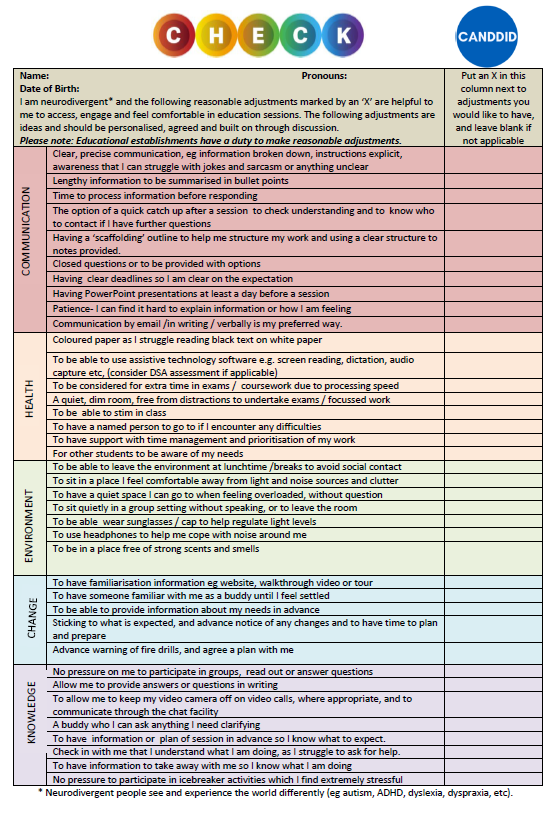
Children often do best when support is put in place early.
If your child is becoming increasingly anxious, distressed or exhausted, share your concerns with the school as soon as possible rather than waiting for difficulties to grow.
Early support can sometimes prevent problems with wellbeing, learning and regularly going to school.
Reasonable adjustments are small changes that help a child take part in school and learning more easily.
Examples include:
- visual timetables
- written instructions
- extra time to process information
- movement breaks
- access to a quiet space
- support with organisation
- preferred seating
- advance warning before changes to routines
The most effective adjustments are based on a child’s individual needs and circumstances.
It is worth discussing access arrangements for exams and assessments with school staff ahead of time.
Access arrangements are changes that help make exams fair for pupils with a disability or learning difficulty, so they can show what they know and can do. They remove barriers without changing what the exam is testing.
Many parents assume that an autism diagnosis automatically means a child is entitled to extra time in exams. This is not always the case.
Schools must be able to show that a pupil’s needs affect their performance in exams. For example:
- slow processing speed
- difficulties with reading
- difficulties with handwriting
- attention and concentration difficulties
- sensory, physical or medical needs
Schools consider information from observations, assessments, examples of work and the support a pupil regularly uses in lessons.
Access arrangements may include:
- extra time
- supervised rest breaks
- a smaller or quieter room
- use of a computer instead of handwriting
- a reader
- a scribe
- modified papers
- support for pupils with hearing or visual impairments
Any arrangements should reflect the pupil’s everyday way of working in school.
If you think your child may need access arrangements, speak to the school’s Special Educational Needs Co-ordinator (SENCo) well before exams take place. This gives the school time to gather information and complete any assessments that may be needed.
Most children can be supported through understanding, reasonable adjustments and regular review.
However, some children need more support than a mainstream school can provide from its existing resources.
If difficulties continue despite support being in place, it may be helpful to discuss whether additional support is needed.
You may wish to ask:
- what support has already been tried
- what has and has not been effective
- what information the school has gathered
- whether further assessments or support may be needed
For some children, this may include an Education, Health and Care Plan (EHCP).
An EHCP is a legal document that describes a child or young person’s needs and the support they require. It can also identify the type of educational setting that is most appropriate for them.
Support plans often focus on difficulties.
It is just as important to talk about:
- strengths
- talents
- interests
- achievements
Hobbies and interests can help children:
- reduce stress
- build confidence
- enjoy learning
- develop friendships
Schools can often use these interests to support learning and wellbeing. Click here for more information about this.
Children’s needs can change over time.
Regular communication helps schools and families understand:
- what is working well
- any new concerns
- whether support needs reviewing
Ways to communicate include:
- emails
- phone calls
- home-school communication books
- review meetings
After an important discussion, it can be helpful to send an email summarising what was agreed. This can reduce misunderstandings and provide a useful record.
As children grow older, it is important to help them understand and communicate their own needs.
This might include helping them to:
- explain what they find difficult
- identify what helps
- share their views
- take part in decisions about support
Some children may want to attend meetings and speak for themselves. Others may prefer an adult to share their views on their behalf.
Both approaches are valid.
Sometimes an autistic child may find going to school more and more difficult.
This is often linked to:
- anxiety
- sensory overwhelm
- bullying
- Exhaustion or burnout
- feeling unsafe
- feeling misunderstood
- support needs not being met
When a child is struggling to go to school regularly, it is often a sign that something is making school feel difficult, stressful or overwhelming for them. It is important to work with your child and their school to understand the reasons behind this and explore what support or changes may help.
Some children can return to going to school regularly once appropriate support is in place. Others may need a gradual return, additional support, a specialist setting or a different approach to education. Click here for more information.
Sometimes families and schools disagree about what support is needed.
If this happens:
- stay calm and respectful
- focus on your child’s needs
- ask for examples and evidence
- keep records of meetings and emails
- follow the school’s complaints procedure if needed
Most families and schools want the same outcome: for the child to be safe, happy and able to learn.
Remember that success is not simply about being present in school. It is about learning, wellbeing, feeling safe, developing confidence and having needs understood and supported.
For some autistic children, this may happen in a mainstream school. For others, a specialist school or different type of educational provision may be more suitable. The right setting is the one that best meets the child’s needs.
Key points

- Your child’s views should be at the centre of decisions about support.
- Good communication helps everyone understand your child’s needs.
- Schools and families may see different parts of a child’s experience.
- Reasonable adjustments can reduce stress and help children access learning.
- Access arrangements for exams are based on evidence of need and normal classroom practice, not simply an autism diagnosis.
- Some children may need additional support through an EHCP.
- Difficulties with going to school are often a sign of unmet needs or high levels of stress.
- Regular communication helps support remain effective.
- Families and schools are most effective when they work together.