
Explaining the link between autism and neurodiversity is quite complex. To understand the key words, it might help to read some definitions from CAPTAP (Community Against Prejudice Towards Autistic People).
Click here to view the language guide by CAPTAP
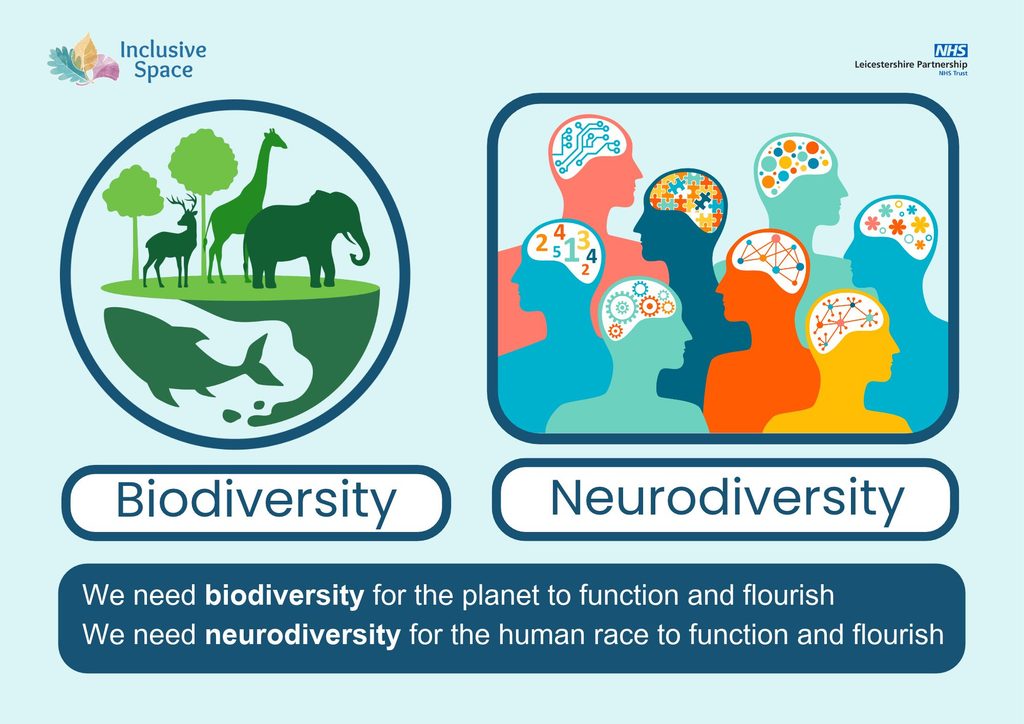
The term neurodiversity was first used in the 1990’s by the autistic online community. It has since been included in the written works of many academics and researchers and is now a popular and respected model of explaining differences in human neurology – or what we might call ‘brain-wiring’.
The neurodiversity model highlights that when it comes to neurology, every person is unique. It recognises that each person’s individual neurology produces unique thinking styles and behaviours.
It also emphasises that these variations in human neurology are normal.
Click below to listen to Mr Auden Allen give an interesting and positive perspective on neurodiversity:
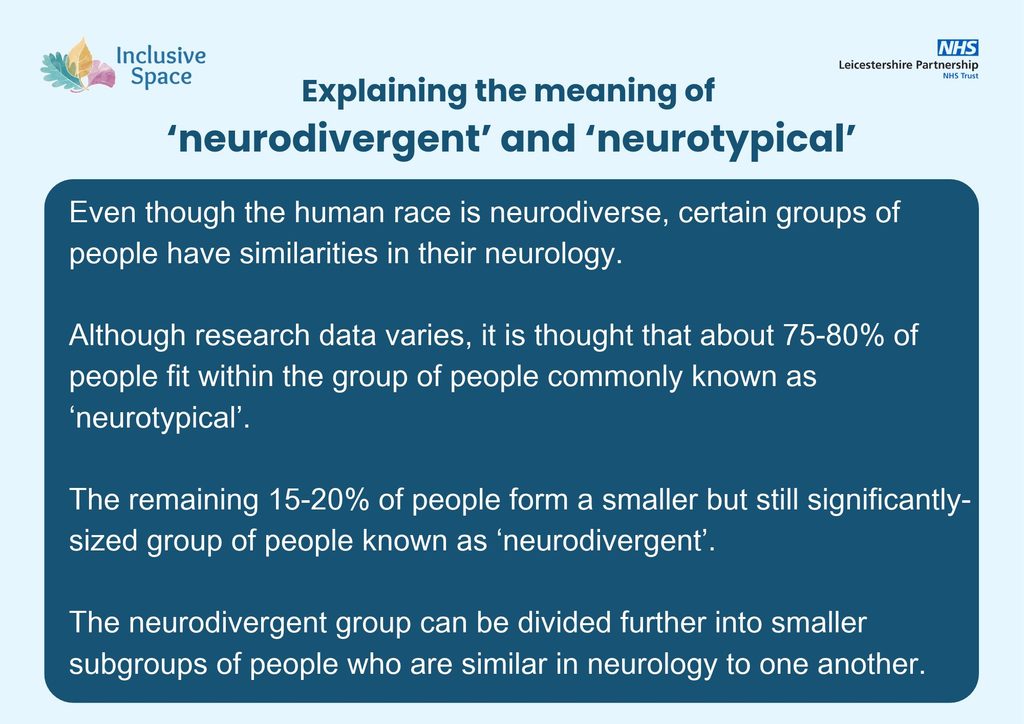
The subgroups of neurodivergent people include those who have the following types of neurology.
- ADHD (Attention Deficit Hyperactivity Disorder)
- Autism
- Developmental Language Disorder
- Dyscalculia
- Dyslexia
- Dyspraxia – also known as Developmental Co-Ordination Disorder (DCD)
- Learning Disability
- Tics or Tourette’s
These types of neurology are known as ‘neurodevelopmental’ which essentially means they are established during early development and are lifelong. They are often known as ‘neurodevelopmental conditions’.
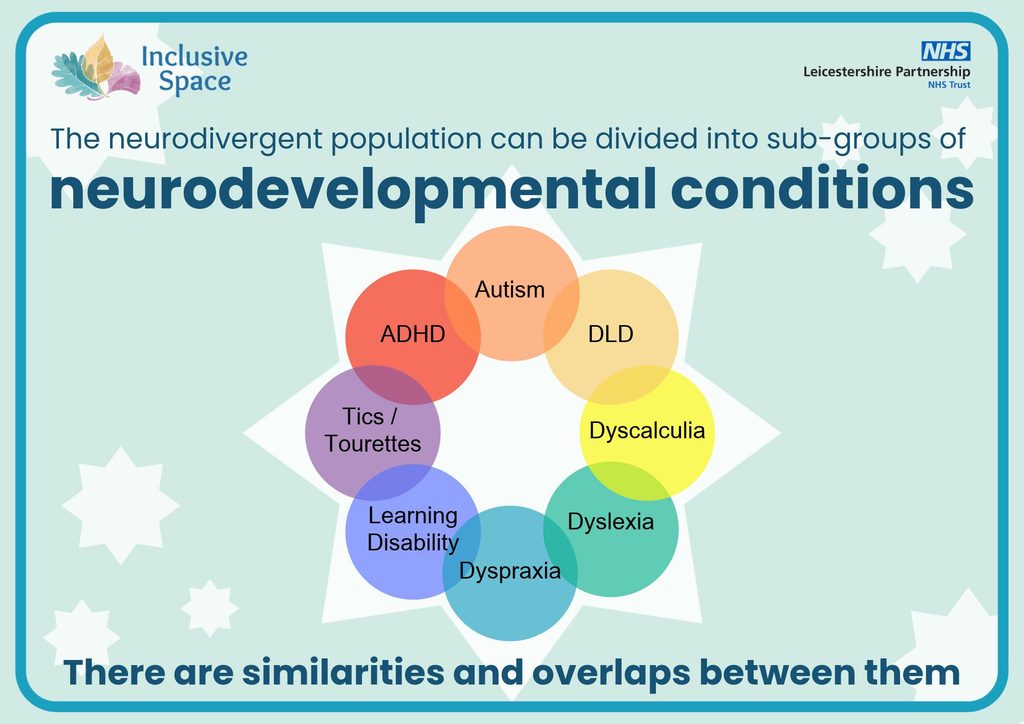
A 2024 Birmingham University study on neurodiversity (source and link at bottom of article) in the UK population showed that:
- There are characteristics and experiences that are common to individual neurodevelopmental conditions.
- It is also possible for two people with the same diagnosis to have rather different features.
- There are also factors that might be common across neurodevelopmental conditions. This means there is considerable overlap of common factors between various conditions.
- People with high levels of characteristics and experiences common to one condition, often also have high levels of characteristics and experiences common to other conditions.
- It is common for people to have more than one neurodevelopmental condition.
About 40% of autistic people also have ADHD. We sometimes call this combination AuDHD.
Autism is not a learning disability – however, as we know, overlaps between neurodevelopmental conditions are common.
It is estimated that about 1 in 3 autistic people also have a learning disability.
About 3 in 10 people with a learning disability also have an autism diagnosis
Click this link to find more details on autism and learning disability from Autistica.
As we know, most people on the planet are neurotypical. Therefore it is fair to say that most systems and environments within society – such as schools and workplaces – are largely designed, set up and maintained by a majority of neurotypical people. And we could say that most of the time, it is the needs of the largely neurotypical population that are catered for, whereas the needs of autistic people are often not fully considered.
When we take this into account and also remember that autistic people’s neurology, thinking and behaviours are different by comparison to those of neurotypical people, it helps us understand why autistic people often face difficulties and challenges.
The neurodiversity model helps to explain why autistic people might also have certain characteristics that can be seen as strengths. It is important to remember that no two autistic people are the same – however, there is evidence to support the fact that autistic people often tend to excel in certain areas.
- being experts in their favourite topics/activities
- the ability to ‘hyperfocus’ i.e. spend a long time engrossed in a particular task
- having a strong sense of justice
- creativity
- ability to notice detail
- honesty
- loyalty
- creative problem solving
- less influenced by socially-derived biases
- excellent memory
Key points

- Every person’s brain works in its own way.
- We call these natural differences in thinking, learning and experiencing the world neurodiversity.
- Many people have similar brain-wiring and thinking styles.
- We call these people neurotypical.
- People whose brain works differently from what is typical are neurodivergent.
- Neurodivergent people include autistic people and people with ADHD, dyslexia, dyspraxia, Tourette syndrome, learning disabilities and some other neurodevelopmental conditions.
- Neurodevelopmental conditions start early in life and continue throughout a person’s lifetime.
- Many people have more than one neurodevelopmental condition. For example, some autistic people also have ADHD or a learning disability.
- People with the same diagnosis can be very different from each other.
- Every person has their own strengths, needs and experiences.
- Most systems and environments, such as schools and workplaces prioritise meeting the needs of neurotypical people because neurotypical people are the largest group.
- Autistic people often face challenges when people, services or environments do not understand or support autistic differences.
- Autistic people often have strengths such as strong interests, attention to detail, creativity, honesty, loyalty, problem-solving skills and a strong sense of fairness.